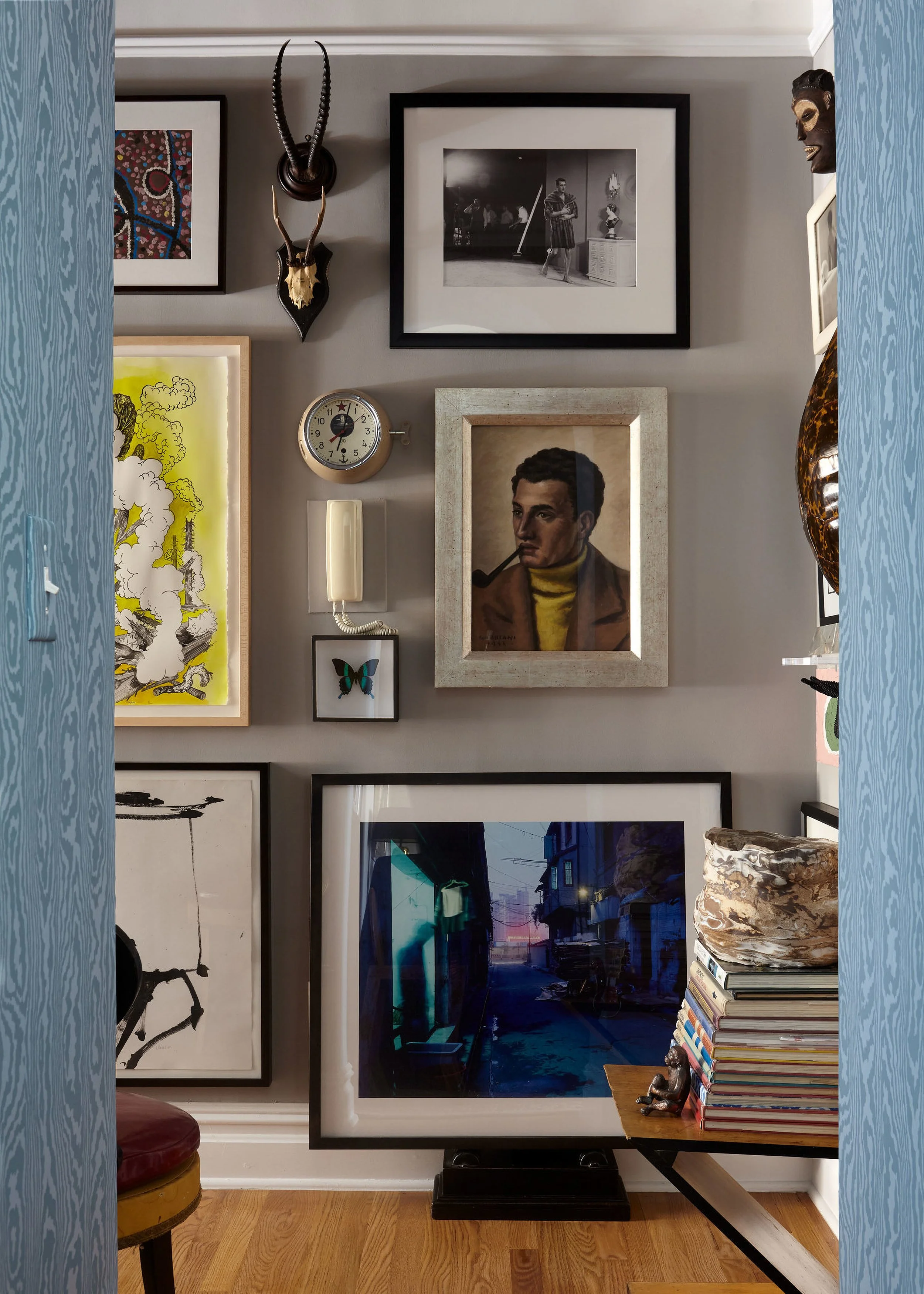
There’s a long-standing assumption in interior design that artwork belongs on the wall; measured, centred, and fixed in place. But increasingly, I find myself moving away from that idea.
For me, a home should feel as though it has developed over time. It should reflect the people who live in it; their experiences, their memories, their instincts, not just a single moment of completion. And when artwork is treated as something permanent, it can interrupt that process.
Instead, I often encourage a more relaxed, flexible approach. One where art isn’t simply hung, but lived with.

Why I Don’t Always Hang Artwork
When every piece is fixed to a wall, a room can start to feel resolved too quickly. There’s a finality to it that doesn’t always sit comfortably within a home that’s meant to evolve.
By contrast, allowing some works to remain unmounted, leaning, resting, or layered, introduces a sense of movement. It creates a quieter kind of composition, one that can shift over time.
This approach also removes a level of pressure. Not every piece needs to justify its placement. Some works can simply exist in the space, ready to be moved, replaced, or rediscovered.

Let Artwork Rest, Not Just Hang
One of the simplest shifts is also the most effective: stop assuming that every piece needs to be hung.
I often place larger works directly on the floor, leaning them gently against a wall. It gives them presence without forcing them into a rigid structure. Smaller pieces can sit on consoles, mantels, or shelves, where they feel integrated into the room rather than separate from it.
There’s an ease to this approach that’s difficult to achieve with traditional hanging.

Work in Layers, Not Arrangements
I’ve never been particularly interested in perfectly aligned gallery walls. They can feel overly composed, almost too certain of themselves.
Instead, I prefer to layer artwork. Let pieces overlap slightly. Allow one frame to sit partially in front of another. Introduce variation in scale and subject.
This creates depth, but more importantly, it introduces a sense of time, like the collection has grown gradually, rather than being installed all at once.

Use Furniture as a Foundation for Art
Art doesn’t need to exist in isolation. In fact, I think it’s far more interesting when it becomes part of a larger composition.
A console table, for example, can hold a framed photograph, a stack of books, and a small object. Together, they create a moment that feels considered but not overly designed.
This is often where a room begins to feel personal, when the boundaries between art, object, and function start to soften.

Create Smaller, Quieter Moments
Not every space needs a focal point in the traditional sense.
Sometimes, it’s more effective to create a series of smaller moments throughout a home. A single painting leaning in an entryway. A group of photographs gathered on a side table. A piece resting casually in a corner.
These gestures don’t demand attention in the same way a gallery wall does, but they contribute to a more layered and nuanced interior.

Keep the Ability to Change Thing
One of the main reasons I avoid fixing everything in place is simple: I want the option to change it.
Art collections aren’t static. New pieces are added. Others lose their relevance. Some need to be seen in a different light, or in a different room entirely.
By keeping the display flexible, whether through leaning, layering, or using adaptable hanging systems, you allow the space to respond to those changes naturally.

Think of Art as Part of Daily Life
Ultimately, I don’t see artwork as something that should sit apart from the rest of the home.
It should be part of daily life, something you move, interact with, and reconsider over time. When it’s not fixed permanently to a wall, it becomes more accessible in that way.
You notice it differently. You engage with it more often. It becomes less of a statement and more of a presence.

A More Evolving Interior
Moving away from hanging artwork isn’t about rejecting tradition altogether. There will always be moments where a piece belongs on the wall, properly placed and carefully considered.
But by introducing a degree of flexibility, by allowing some works to remain unmounted, you create space for a different kind of interior. One that feels ongoing rather than finished.
That, to me, is where a home becomes most interesting.